
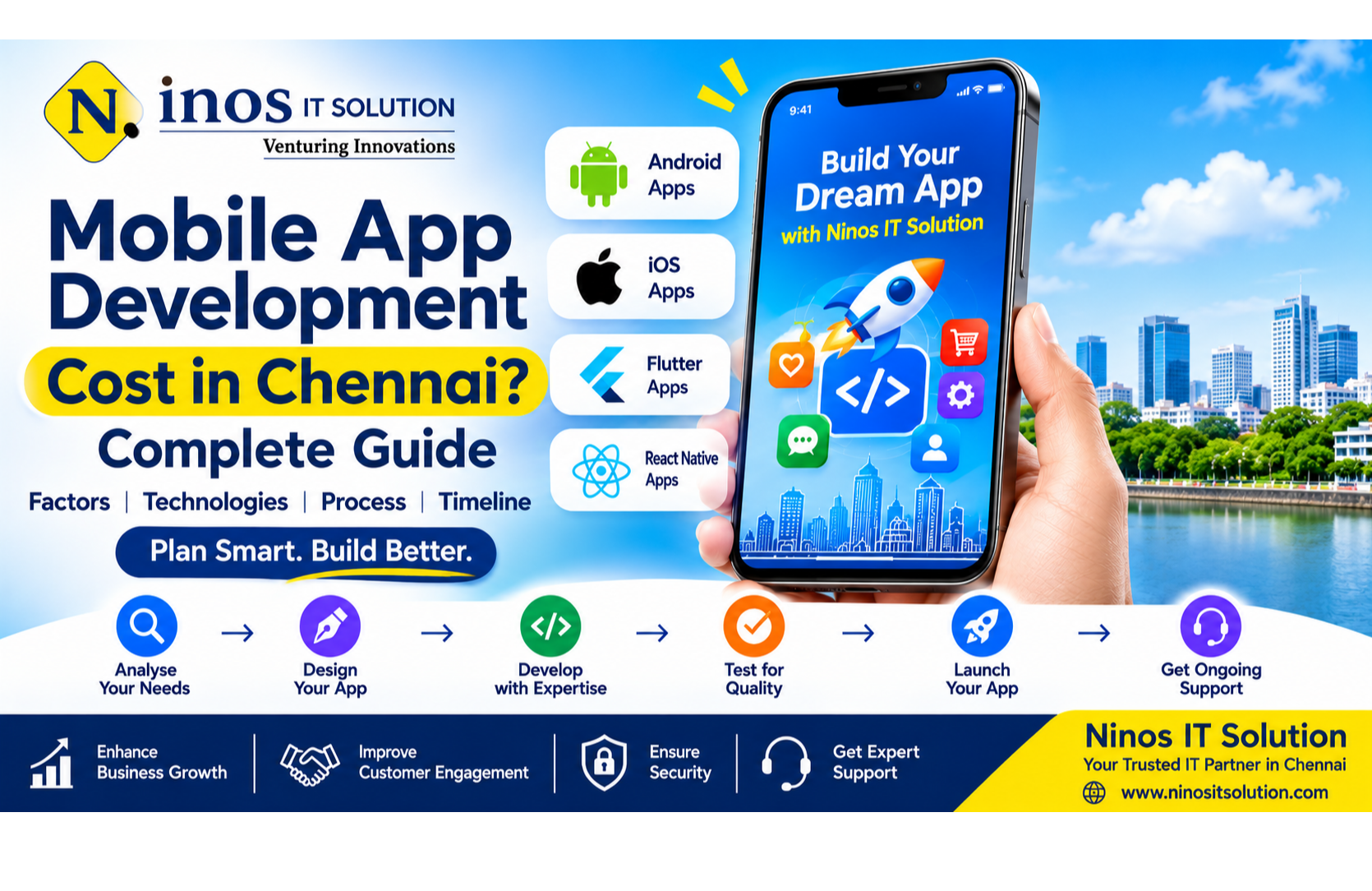
Are you planning to develop a mobile application for your business but unsure about the development cost?
Mobile applications have become an important part of modern business operations. From e-commerce and healthcare to education, logistics and service-based businesses, mobile apps help companies connect with customers, automate processes and deliver better digital experiences.
However, the cost of developing a mobile application varies depending on its features, design, technology, integrations and overall complexity.
If you are searching for mobile app development cost in Chennai, this guide explains the major cost factors, different types of applications, technology options, development timelines and how to plan your mobile app budget.
Mobile app development costs depend on the specific requirements of each project. A simple business application requires fewer development resources than a large e-commerce or enterprise application.
The total investment generally depends on:
Number of application features.
Android, iOS or cross-platform development.
UI/UX design complexity.
Backend and database requirements.
Third-party API integrations.
Payment gateway integration.
Security and testing requirements.
Maintenance and ongoing support.
Instead of choosing a development company based only on the lowest quotation, businesses should evaluate the technical quality, development process, scalability and long-term support.
A detailed project estimate should be prepared after understanding the application requirements.
Different business applications require different development approaches and functionalities.
A basic business application is suitable for companies that want to provide information and simple services through a mobile platform.
Common features include:
User registration and login.
Business information.
Service listings.
Contact forms.
Push notifications.
Basic admin management.
An e-commerce application allows businesses to sell products and manage online orders through mobile devices.
Common features include:
Product catalogue.
Product search and filters.
Shopping cart.
Secure payment gateway.
Order management.
Delivery tracking.
Customer accounts.
Admin dashboard.
On-demand applications connect customers with service providers.
Common features include:
Customer registration.
Service provider registration.
Location-based services.
Booking management.
Real-time notifications.
Payment integration.
Booking status tracking.
Customer reviews.
Healthcare applications help patients and healthcare providers manage appointments and related services.
Common features include:
Patient registration.
Doctor profiles.
Appointment scheduling.
Consultation management.
Notifications and reminders.
Secure patient information.
Admin dashboard.
Enterprise applications are designed to support internal business operations and complex workflows.
Common features include:
Employee management.
Role-based access.
Inventory management.
CRM and ERP integration.
Business reports.
Workflow automation.
Advanced security.
The development investment increases when applications require complex integrations, multiple user roles, real-time processing and advanced backend functionality.
Choosing the right technology is an important part of mobile app budget planning.
Android applications are commonly developed using Kotlin or Java.
Android development is suitable for businesses targeting Android smartphone users and applications requiring Android-specific functionality.
iOS applications are developed primarily using Swift.
This option is suitable for businesses targeting Apple device users and requiring native integration with the Apple ecosystem.
Flutter is a cross-platform framework that uses Dart.
It allows developers to build applications for Android and iOS using a shared codebase for many common requirements.
React Native uses JavaScript or TypeScript and allows businesses to develop applications for Android and iOS with shared components and code.
| Technology | Development Approach | Suitable For |
|---|---|---|
| Android Native | Separate native development | Android-focused apps |
| iOS Native | Separate native development | Apple-focused apps |
| Flutter | Shared cross-platform code | Android and iOS applications |
| React Native | Shared cross-platform code | Cross-platform applications |
Which option is more cost-effective?
Cross-platform development can reduce duplicated development effort when the application requirements are suitable. However, the final cost depends on native functionality, integrations, performance requirements and platform-specific customization.
Understanding the following factors helps businesses prepare a realistic development budget.
Application design influences both development effort and user experience.
A simple application with standard layouts generally requires less design work than an application with custom dashboards, animations and complex user journeys.
The number and complexity of features directly influence development effort.
For example, user login and a basic dashboard are relatively straightforward compared with real-time tracking, advanced reporting and multi-user workflows.
Backend development manages application data, user accounts, business logic, authentication and server-side operations.
Applications requiring complex backend functionality generally need additional development resources.
Third-party integrations can increase project complexity.
Examples include:
Payment gateways.
Google Maps.
CRM systems.
ERP platforms.
SMS and email services.
Cloud storage.
Social login services.
Applications handling personal information, financial transactions or business data require appropriate security measures.
These may include secure authentication, encrypted communication, access control, API protection and security testing.
Applications must be tested across supported devices, operating system versions and screen sizes.
Testing helps identify functional issues, compatibility problems, performance limitations and security vulnerabilities.
A structured development process helps businesses manage project scope, quality and delivery timelines.
The development team understands the business objectives, target audience, application features and technical requirements.
Wireframes, user journeys and application interface designs are prepared before development begins.
The suitable development framework, programming languages, database and backend architecture are selected.
Developers build the frontend, backend, database connections and required integrations.
The application undergoes functional, performance, security and compatibility testing.
The application is prepared for release through the Google Play Store and Apple App Store, subject to their respective requirements and review processes.
After deployment, the application requires monitoring, bug fixes, security updates and feature improvements.
Development time depends on the project's complexity and scope.
| Application Type | Indicative Timeline |
|---|---|
| Basic Business App | 4–8 weeks |
| Medium Complexity App | 8–12 weeks |
| E-commerce App | 10–16 weeks |
| On-Demand Service App | 12–20 weeks |
| Enterprise Application | 16–24+ weeks |
These are indicative planning estimates. Actual delivery time depends on feature requirements, design approvals, integrations, testing and project dependencies.
Businesses can manage their development budgets without compromising essential application quality.
A Minimum Viable Product (MVP) includes the essential features needed to launch the application and validate the business idea.
Additional features can be introduced based on customer feedback and business requirements.
Prepare a detailed list of required features before development starts. This helps reduce scope changes and unnecessary development work.
Select native or cross-platform development based on actual technical requirements rather than following technology trends.
Separate features into essential, important and optional categories.
Develop the most important functionalities first.
Choose an architecture that can support future enhancements without requiring unnecessary redevelopment.
Consider ongoing server expenses, third-party service charges, security updates and application maintenance when calculating the overall investment.
Selecting the right development partner is as important as choosing the right technology.
Before finalizing a company, evaluate:
Relevant mobile application development experience.
Android, iOS and cross-platform expertise.
UI/UX design capabilities.
Previous project portfolio.
Backend and API development skills.
Application security practices.
Testing and quality assurance process.
Project communication and delivery approach.
Post-launch maintenance support.
Clear project scope and quotation.
Ask for a detailed proposal that explains the features, technology, deliverables, timeline and support arrangements.
Avoid selecting a company based only on a low initial quotation. Understand what is included and what may involve additional charges.
Choosing a development partner who understands your business requirements can make the application development process more effective.
Ninos IT Solution provides IT and digital development services for businesses looking to build and improve their digital presence.
When planning a mobile application, businesses should evaluate the following areas with their development partner:
Business requirement analysis.
Custom mobile application planning.
Android and iOS development options.
Flutter and React Native solutions.
UI/UX design and prototyping.
Backend and API integration.
Application testing and deployment.
Ongoing maintenance and technical support.
The development approach should be based on your business objectives, target users, application requirements and long-term plans.
Contact Ninos IT Solution to discuss your mobile application requirements and request a project-specific consultation.
Mobile app development cost in Chennai depends on the application's complexity, features, design, technology and integrations. A basic business app generally requires less development effort than an advanced e-commerce or enterprise application. A project-specific quotation is recommended.
Starting with an MVP is one practical approach. Focus on essential features, select suitable technology and introduce additional functionalities as your business grows.
Not necessarily. Both platforms have different technical requirements. The actual development cost depends on the application's features, design, integrations and development scope.
Flutter can reduce duplicated development effort because Android and iOS applications can share much of their codebase. However, the cost advantage depends on project requirements and native functionality.
The cost depends on product management, shopping cart functionality, payment gateway integration, order management, delivery tracking and admin panel requirements. Advanced features increase development effort.
Yes. Frameworks such as Flutter and React Native support cross-platform development. They allow developers to share significant portions of application code across Android and iOS.
Not necessarily. Hosting, cloud infrastructure, domain services, third-party API subscriptions and other recurring expenses may be quoted separately. Confirm these costs before approving a project.
A basic mobile application may take approximately 4–8 weeks, while medium-complexity applications may take 8–12 weeks. Complex applications can take several months.
Maintenance depends on the agreement with the development company. Confirm whether bug fixes, security updates, operating system compatibility and ongoing technical support are included.
Prepare your business requirements, preferred platforms, required features and expected timeline. Share these details with a mobile app development company to receive a project-specific estimate.
Mobile app development is an important investment for businesses looking to improve customer engagement, automate operations and expand their digital services.
The overall cost depends on the application type, technology, features, integrations, design and long-term maintenance requirements.
Before starting your project, clearly define your business objectives, prioritize essential features and select a development approach that supports future growth.
Looking for a Mobile App Development Company in Chennai?
Ninos IT Solution can help you explore mobile application development options based on your business requirements.
Contact the team to discuss your project, technology preferences and development requirements.
Website: https://www.ninositsolution.com/
13 November 2026
12 November 2026

3 October 2026
30 September 2026
28 September 2026



D-U-N-S Number : 860501484
Privacy Policy Terms of Service
© 2023 ALL RIGHTS RESERVED. DESIGNED BY NINOS IT SOLUTION DEVELOPED BY ECPHASIS INFOTECH